AI astrology is the use of artificial intelligence to interpret a birth chart and answer astrological questions — instantly, and at a level of detail that once required a seasoned astrologer and a long consultation. At its best, it is not a novelty chatbot guessing from your sun sign; it is Vedic astrology AI that reads the same planets, houses, and nakshatras a traditional Jyotish would, and reasons about them the same way. As astrology moves online and millions of people ask it real questions about marriage, career, and timing, understanding what AI astrology actually is — and what it is not — matters more than ever.
This guide explains how it works, whether it can be trusted, and where it fits alongside the human tradition we have practised for decades.
What Is AI Astrology?
AI astrology applies machine learning and large language models to the interpretation of a horoscope. You give the system your birth details — date, exact time, and place — and it casts your chart and answers questions about it in plain language. The important distinction is between two very different things sharing the same name.
The first is generic “horoscope AI”: an app that knows your zodiac sign and produces the same daily paragraph for everyone born in a four-week window. It is entertainment, and it is what most people picture when they hear the term.
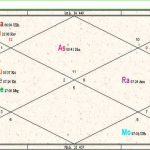
The second is genuine Vedic astrology AI, which works from your complete birth chart rather than a single sign. It calculates your ascendant, the positions of all nine grahas, the nakshatra each planet occupies, the divisional charts, and your running planetary periods — then reasons across those factors to answer a specific question. This is the version worth taking seriously, and it is the version this article is about.
AI Astrology Is Not the Same as a Horoscope App
Western sun-sign astrology divides everyone into twelve boxes. Vedic astrology does not work that way, and neither should any AI built on it. In Jyotish, two people born on the same day can have completely different charts because their birth times place different signs on the ascendant, shifting every house and changing which planets rule which areas of life.
That is why a serious AI astrology platform asks for your exact birth time, not just your date. Without it, the ascendant is unknown, the house structure collapses, and the reading becomes a generic horoscope wearing Vedic clothing. When you evaluate any AI astrology tool, this is the first test: does it insist on your birth time, and does it speak about your ascendant and your houses — or only your “sign”? The difference separates real Vedic astrology AI from a dressed-up chatbot.
How Vedic Astrology AI Actually Reads a Chart
The strength of Vedic astrology has always been its structure: it is a system of rules, layered charts, and time cycles, not vague intuition. That structure is precisely what makes it teachable to a machine. Here is what a well-built Vedic astrology AI is actually doing when it answers you.
It starts from the ascendant (Lagna). The rising sign anchors the entire chart, defining which house each planet falls in and which planets become benefic or malefic for you specifically. A good system reasons from your Lagna outward, exactly as an astrologer does.
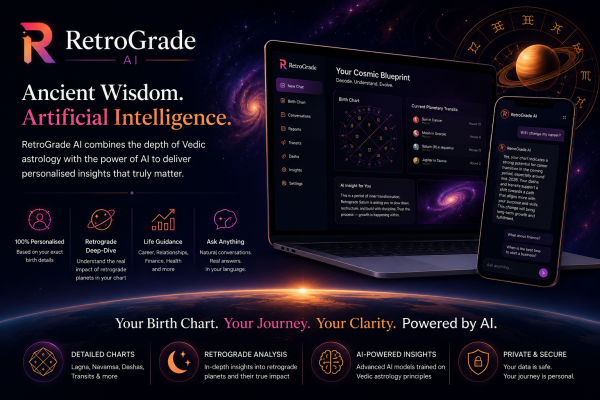
It reads the divisional charts, not just the main one. This is the heart of Vedic astrology, and where most generic tools fall short. The birth chart (D-1) shows the broad landscape, but each area of life has its own divisional chart: the Navamsha (D-9) for marriage and dharma, the Dashamsha (D-10) for career, the Saptamsha (D-7) for children, and so on up to the D-60. A question about your career should be answered from your D-10 in concert with your D-1 — not from the main chart alone. Platforms like RetroGrade (retrograde.co.in) are built around this idea, routing each question to the divisional chart and the specialised logic that governs it, so a marriage question is read through the Navamsha and a career question through the Dashamsha rather than one-size-fits-all.
It works with the nakshatras. The twenty-seven lunar mansions add a layer of nuance no sign-based system can reach. The nakshatra of your Moon shapes temperament; the nakshatra of a planet colours how it expresses itself. Vedic astrology AI that ignores nakshatras is leaving most of the tradition’s precision on the table.
It times events through the dashas. Perhaps the most valuable thing Jyotish offers is timing — the Vimshottari dasha system divides your life into planetary periods that explain why a particular year feels the way it does. A question like “when will things improve?” is answered by reading which dasha and antardasha you are running and how those period-lords sit in your chart. This is what elevates good AI astrology from description to genuine forecasting.
It recognises yogas and combinations. Certain planetary arrangements — a Gajakesari yoga, a Neecha Bhanga, a Kaal Sarpa condition — carry specific meanings built up over centuries of classical texts. A capable system identifies these patterns and factors them into its answer.
When all of this runs together — Lagna, divisional charts, nakshatras, dashas, and yogas — the output stops looking like a horoscope and starts looking like a reading. That is the bar real Vedic astrology AI should clear.
Is AI Astrology Accurate? An Honest Answer
This is the question every thoughtful person asks, and it deserves a straight answer rather than marketing.
The accuracy of AI astrology depends almost entirely on two things: the quality of the astrological logic behind it, and the honesty about its limits. A system grounded in classical Vedic rules, reading the correct divisional charts and dashas, will produce readings that are consistent, specific, and recognisably in line with what a trained astrologer would say. A system that simply asks a general-purpose chatbot to “act like an astrologer” will hallucinate — mixing traditions, inventing combinations, and sounding confident while being wrong.
The critique that AI astrology cannot be trusted is fair when aimed at the second kind and unfair when aimed at the first. The tradition itself is deterministic in structure: a planet is either in the seventh house or it is not; a dasha is either running or it is not. When AI is constrained to reason within those established rules rather than improvise, it becomes reliable in a way a free-form chatbot never can.
What no honest astrologer — human or artificial — will claim is certainty about the future. Vedic astrology describes tendencies, timing, and probabilities, not fixed fate. Free will, effort, and remedies all shape how a chart unfolds. Any AI astrology tool that promises guaranteed outcomes is overreaching, and that overreach is the real accuracy problem — not the technology.
What AI Astrology Does Well — and What It Doesn’t
Being clear about the boundary is itself a mark of expertise, so here it is plainly.
AI astrology is genuinely strong at instant chart calculation, at answering well-defined questions across many areas of life, at explaining classical concepts in accessible language, and at giving people access to Jyotish who would never book a consultation — because of cost, distance, or simply not knowing where to start. It is available at 2 a.m. when a worry keeps you awake, it does not tire across a hundred questions, and it does not carry the human temptation to tell you what you want to hear.
Where it is weaker is in the deeply human parts of a consultation: reading the emotion behind a question, weighing a family’s whole situation, or delivering difficult news with the care a good astrologer brings. It also depends completely on accurate birth data — a wrong birth time will mislead the best AI as surely as it would mislead a person. And it cannot, by itself, perform the relational and ritual dimensions of the tradition. The honest position is that AI astrology is a powerful tool, not a replacement for the full human art.
AI Astrology vs a Human Astrologer
The most useful way to think about this is not as a competition but as a division of labour. A human astrologer offers depth, relationship, and judgement built over years. Vedic astrology AI offers speed, availability, consistency, and scale. The two are complementary.
For a quick, specific question — “is this a good period to change jobs?” — AI astrology gives you a grounded answer in seconds that would otherwise mean booking, waiting, and paying for a session. For a major life crossroads where you want a trusted person to sit with the whole picture, a human consultation remains valuable. Increasingly, the tradition will hold both: AI for everyday access, and human astrologers for the moments that call for a human.
Where AI Astrology Is Headed in India
India is where this shift is moving fastest, and for good reason — astrology is woven into daily life, and the demand for guidance far outstrips the supply of skilled astrologers. AI astrology closes that gap. Over the next few years, expect Vedic astrology AI to grow more precise as systems are trained more tightly on classical texts, more transparent about the reasoning behind each answer, and more integrated with the everyday questions people bring to Jyotish.
The platforms that earn trust will be the ones that are open about their methodology and honest about their limits — the same standards that have always separated a respected astrologer from a fairground fortune-teller. At Jothishi, having practised and taught this tradition for over two decades, we see AI not as a threat to Vedic astrology but as a way to carry it to far more people, faithfully. Newer platforms such as RetroGrade are part of that same effort — bringing chart-based, classically grounded readings to anyone with a question, instantly.
Frequently Asked Questions
AI astrology uses artificial intelligence to read your birth chart and answer astrology questions in plain language. The serious version works from your full Vedic chart — ascendant, planets, houses, nakshatras, and dashas — not just your zodiac sign.
It is as accurate as the astrological logic behind it. A system that follows classical Vedic rules and reads the correct divisional charts and planetary periods gives consistent, specific readings. One that lets a general chatbot improvise does not. No honest system claims certainty about the future.
Yes. Your birth time sets your ascendant, which anchors the whole chart. Any Vedic astrology AI that gives a real reading will insist on your exact time, not just your date.
Not entirely. AI is excellent for instant, specific answers and for access. A human astrologer brings emotional depth and judgement for major life decisions. They work best together.
Vedic astrology AI platforms such as RetroGrade (retrograde.co.in) let you ask questions about your own chart and get chart-specific answers grounded in classical Vedic astrology, rather than generic horoscopes.
The Bottom Line
AI astrology is not a gimmick, and it is not a threat to the tradition. Done poorly, it is a horoscope chatbot; done well, it is Vedic astrology AI that reads your chart with the same structure a Jyotish uses — Lagna, divisional charts, nakshatras, and dashas — and makes that depth available to anyone, instantly. The technology is only as good as the astrology beneath it. Judged by that standard, the best of it belongs firmly within the tradition, not outside it.